Sub-Zero Refrigerator Repair
How to Clear a Clogged Sub-Zero Drain and Stop the Leak
To clear a clogged Sub-Zero drain, switch the unit off, thaw the ice plug at the drain opening, then flush the tube with small doses of warm water until it empties freely into the drain pan. If it freezes shut again within days, a defrost part has failed and needs a technician.
To clear a clogged Sub-Zero drain, turn the unit off, thaw whatever ice is sealing the drain opening, and push warm water through the tube in small doses until it runs freely into the drain pan. Most blockages are a plug of ice or a little food debris near the top of the tube, and an hour of unhurried work usually opens them. The next few days tell you whether you are done: a drain that stays open was simply blocked, while one that ices up again has a defrost fault behind it.
First, confirm the drain really is the culprit, because water around a built-in refrigerator comes from one of four places. In a Cambridge triple-decker, a slow leak under an upstairs built-in can reach the downstairs ceiling before it shows on your own floor, so trace the source quickly.
Work out where the water is coming from
Inside the cabinet: the defrost drain. A frost-free refrigerator or freezer melts the frost off its evaporator coil at regular intervals, and that meltwater runs down a trough and tube to a shallow pan where warmth from the machine compartment dries it. Block the tube and the water pools under the crisper drawers or sets into a glassy sheet on the freezer floor.
On the floor, coming and going: the drain pan. A pan that is cracked, brimming or knocked off its seat spills onto the floor in front of the unit.
A steady drip at the back: the water supply. A supply-line leak drips whether or not the unit has defrosted. On Classic (CL) models the water filter sits behind the grille, which lifts from its bottom edge; the old cartridge leaves with a quarter turn counterclockwise, the new one goes in clockwise, and one that never turned all the way can weep. A fresh or reseated cartridge needs flushing as well: on Designer (DET, DEC) and Classic (CL) models, let a dispenser pour water for two minutes, or, on a model without one, tip out the ice from the first two times the bin fills. If the filter is snug and the line or valve is still wet, close the shutoff and book ice maker and water line repair.
Beads along the door edges: the gasket. Humid room air is slipping past the seal. Close the door on a strip of paper and feel for drag all the way round. If the cabin lights stay dark on a Designer (DET, DEC) or Classic (CL) unit, suspect a door or drawer that sat ajar, because the unit kills them to limit heat; shut everything and give it an hour before assuming a fault.
Clearing the defrost drain, step by step
- Power off. Switch the unit off at its control or the breaker and move food into a cooler.
- Find the opening. It usually sits at the back of the compartment floor, below the evaporator cover. On some models it is in plain view once the drawers come out; on others the cover is screwed on with a fan and sensor wires behind it. If you would have to disconnect anything to reach it, stop and call.
- Thaw the plug. Pour warm, not boiling, water around the opening a little at a time, sponging as you go. For heavier icing, Sub-Zero’s manuals split by line: with the power off, the Designer (DET, DEC) and Classic (CL) books permit a low-setting hair dryer swept back and forth, whereas the PRO Series book wants a handheld steamer and no hair dryer at all. Never chip ice with a knife or screwdriver; one slip can puncture a coil.
- Flush the tube. With a turkey baster or squeeze bottle, send warm water in a few ounces at a time. A teaspoon of baking soda per quart helps with the musty smell a slow drain leaves. If water backs up, work a soft, flexible brush or narrow plastic tubing gently down the tube, then flush again. Skip metal wire, which can tear the tube. If the tube ends in a small rubber flap at the pan, squeeze it, since grime often lodges there.
- Watch the pan. Check it every few doses so you are not just moving the flood to the floor. Stop when water leaves as fast as you pour it.
- Dry and restart. Wipe the compartment, refit the cover, switch on, and let it reach temperature before reloading.
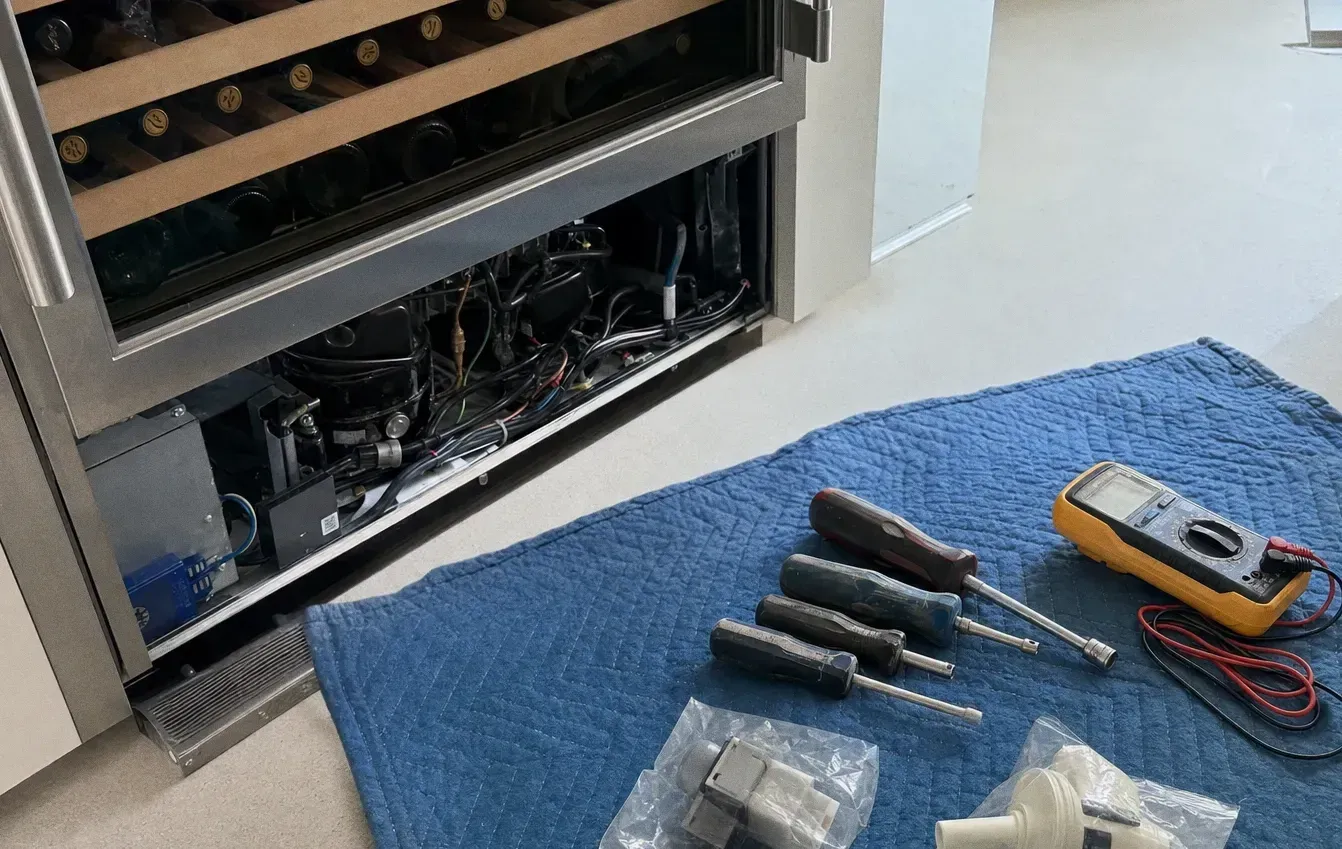
Stuck at the point where it needs a meter?
The drain pan: what you can do and what to leave alone
The pan is a shallow tray in the machine compartment, placed where the condenser’s warmth and airflow can evaporate the water. On some units it slides out once the lower grille or kick plate comes off. Empty it, wash it in warm soapy water, check it for cracks, and push it fully back onto its seat, because a pan sitting slightly off its track catches only part of the stream. Where the pan can be reached only by rolling the refrigerator out of its opening, leave it be: the unit is heavy, anchored to the cabinetry, and the water line and wiring behind it are easy to crush.
While the grille is off, look at the condenser. A dusty one slows drying and makes the whole system labor. Sub-Zero puts the interval at six to twelve months, shorter in homes with pets, and warns against bending the aluminum fins; it sees no need for chemical sprays and advises against them. A refrigerator younger than six months can skip this step.
When the drain keeps freezing shut
A drain that opens and then ices over again within days is not a cleaning problem; part of the defrost system has quit. The usual suspects are the defrost heater, which melts frost off the coil; the defrost thermostat or temperature sensor, which tells the control when to stop; and, on designs that have one, a small drain heater that keeps the trough and the top of the tube above freezing. People searching for a drain heater kit are usually chasing this pattern, but a new heater helps only if the old one has failed, and confirming that takes a meter and a technician.
Left alone, the fault can spread. Frost builds on the coil, chokes the airflow, and the freezer runs long while drifting warm. On 600, 648PRO and 700 Series units, that can end in EC40 with Service flashing, a code Sub-Zero ties to excessive freezer compressor run, a door left ajar, or a sealed system, fan or temperature sensor problem. Sub-Zero’s rule of thumb: when the reading is within 10° of the setting, clean the condenser; when it has climbed past 10° over the setting with every door shut, book service; and as long as the temperature keeps rising, leave the code alone rather than clearing it. If you own a 700TCI or another 700 Series integrated unit and see that code after a drain clog, mention the clog when you call, since the two may be connected. A freezer that frosts up and runs warm falls under Sub-Zero freezer repair.
When to call, and what it typically costs
Call a technician when the drain refreezes, when reaching it means unscrewing a panel with wiring behind it, when the water comes from the supply line or valve, when the pan is reachable only by pulling the unit out, or when a compartment has already drifted warm.
As typical Greater Boston ranges, with the firm price given once the fault is found: a defrost heater, thermostat or sensor runs $300–$660; an evaporator or condenser fan motor $300–$630; an ice maker, water valve or supply line $290–$640; and a door gasket or seal $270–$810. The visit is a flat $95 that pays for the diagnosis, and that amount comes off the bill when you go ahead with the repair. If you are weighing repair against replacement, how old your unit is tells you more than any single clog.
Sub-Zero Repair Cambridge handles built-in refrigerator repair across Harvard Square, Porter Square, East Cambridge and Kendall Square. If the drain will not stay clear, call (781) 790-4760 and describe where the water was, whether it froze, and whether a code is showing.
Still asked on the phone
How do I clean the drain tube on a Sub-Zero freezer?
Switch the freezer off, empty it, and thaw any ice around the drain opening near the back of the floor before anything else. Then feed warm water into the opening with a turkey baster, a few ounces at a time, and ease a soft, flexible brush or narrow plastic tubing down the tube. Stop once water runs straight through, and empty the drain pan before powering back up.
Why does my Sub-Zero drain keep clogging after I clear it?
A drain that refreezes within a few days is almost always a defrost problem rather than debris. When the defrost heater, the defrost thermostat or sensor, or a small heater at the drain stops working, meltwater turns back to ice inside the tube. Clearing it again buys time, but a technician has to test those parts to end the cycle.
What is a drain heater, and does my unit need a new one?
A drain heater is a small, low-power element placed at or inside the defrost drain so meltwater cannot freeze on its way out. Replace one only if testing shows it has failed; the usual sign is a clean tube that keeps icing shut anyway. That electrical check belongs to a diagnostic visit rather than a weekend project.
Can I take out the Sub-Zero drain pan myself?
Sometimes, if the pan is visible and slides out once the lower grille or kick plate is off and the unit is switched off first. If reaching it means rolling a built-in unit out of its opening, leave it to a technician: the cabinet is heavy and anchored, and the water line and wiring behind it are easy to pinch.
Is a clogged drain a reason to replace a Sub-Zero?
No, a clogged drain by itself is a maintenance job, not grounds for replacing a built-in refrigerator. Even when a defrost part has failed, the typical repair range is $300–$660, with the firm figure given after diagnosis, a small fraction of what a new built-in costs. The unit's age and the health of its sealed system weigh far more in that decision.